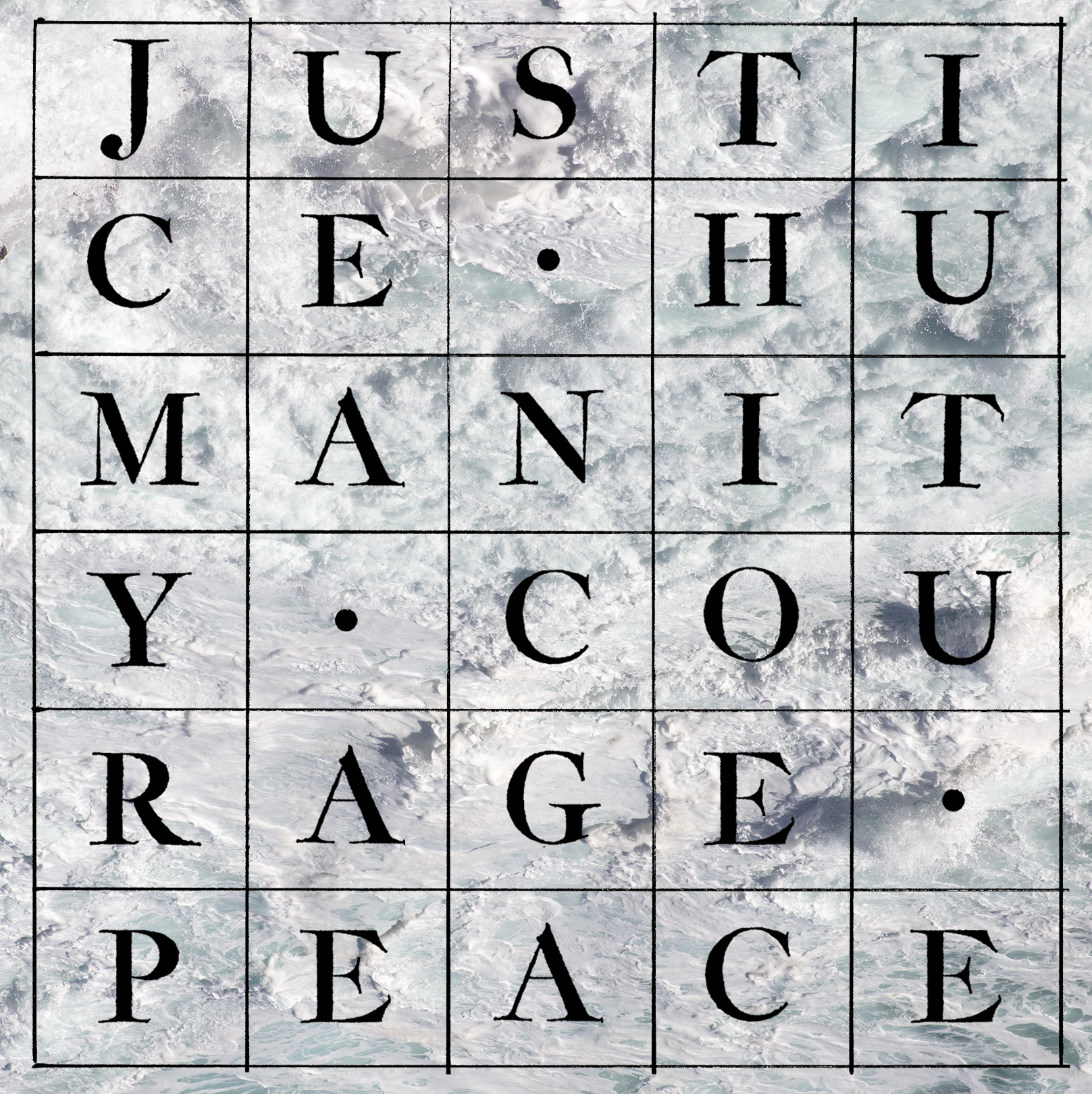
Sentiments of JUSTICE, HUMANITY, COURAGE, and PEACE
DRUM SET: Justin Brown
HORNS: Anonymous*, Emily Pesavento, Melia Badalian, Sarah Bach
TRUMPETS: Dan Rosenboom*, Adam Bhatia, Erick Jovel, Sarah Bauza
TROMBONES: Steve Suminski*, Lori Stuntz, Rose Doylemason, Byron Sleugh
EUPHONIUMS: Jeremy Swem, Phil Keen
TUBA: P Blake Cooper
CONDUCTOR: SiHyun Uhm
Produced by Nick DePinna and Hitomi Oba
Recorded by Sergey Parfenov and Stuart Schenk
Mixed by Brian Montgomery
Mastered by Paul Zinman
Assistant Producers: Ennis Harris and Tom Terrell
Consultant: Bradley Stires
Cover Photography by Eron Rauch
Cover Design by Jesse Rimler
Recorded June/July 2025 at the Evelyn and Mo Ostin Recording Studio at UCLA the Herb Alpert School of Music
Artificial intelligence was not used in the creation of this work.
Release notes by H. Robert Baker
“Sentiments of JUSTICE, HUMANITY, COURAGE, AND PEACE” takes its name from a 1775 essay printed in the Pennsylvania Journal and Weekly Advertiser. Although published anonymously, many have suspected that the author was none other than Tom Paine—the infamous scribbler of Common Sense and The American Crisis, two of the most effective cases ever laid out for American independence. Paine’s authorship of this essay is unlikely, but it is expressive of a reform effort of which he approved, and it ended with a powerful declaration that staked its argument for abolition in a universal appeal: These are the Sentiments of JUSTICE AND HUMANITY.
However bold, one feels the author’s loneliness. There were barely a handful of antislavery essays in the world of eighteenth-century letters. Slavery was, after all, an ancient institution, hallowed by tradition and Scripture alike. And to advocate for its abolition threatened some of the most powerful and wealthy men in the British Atlantic.
Yet people did. From Olaudah Equiano to Anthony Benezet, from Granville Sharp to Prince Hall, courageous voices emerged. They found common cause in a new language of Enlightenment. The force of their arguments stirred action. The very first antislavery society was founded in 1776 in Philadelphia, a year after the publication of the essay. One-hundred years later, chattel slavery was gone from North America.
Nick DePinna’s “Sentiments” articulates through music the themes of justice and humanity, adding to them other values central to shared human existence—courage and peace. The musical notes are drawn from classics of Americana that range across two centuries, from the acapella, colonial-era choral hymns to patriotic music of the nineteenth century.
This is no exercise in polite nostalgia or patriotic pastiche. True, DePinna pieces musical fragments together deliberately, but not quite linearly. They are a narrative, but they do not quite tell a story. Or, at least, not a simple one.
Much of the first part of “Sentiments” is drawn from William Billings’s patriotic hymn “Chester,” which depicts the war for independence in stark terms: “Let tyrants shake their iron rod, let slavery clank her galling chains, we fear them not we trust in God.” The notes are drawn faithfully from Billings’s four-part chorale, but the vertical sonorities are rotated and stretched so as to create new melodies and harmonies out of the old cloth. And while the brass interpret the notes on the page, the solo drummer improvises.
There is tension here. The brass invoke themes of solidarity and sacrifice, while the drummer begins a driving meditation on the themes of justice, humanity, courage and peace. The brass soar and swell. The drummer agitates, fades, reignites and assumes leadership. These are complicated conversations. Does one voice bolster the other? Who pushes who forward? Does their conversation itself transform the central themes? The tension does not fray the music’s coherence, but it sets it on a knife’s edge. Resolution is elusive.
Such compositional decisions betray DePinna’s ambivalence with his source material. And why not? The 1775 antislavery essay ends with a queasy appeal to the moral dividends of abolition—grateful freedmen will gladly spread the Christian gospel to Africa. Perhaps it was a rhetorical ploy, designed to sway those Christians on the fence into the antislavery camp. It still sullies the just principle.
“Chester” offers ringing endorsements of solidary and sacrifice in the face of tyranny, but even here we see evidence of bigotry. Tyrants may shake their iron rod, but the song confidently announces that “New England’s God forever reigns,” a declaration so provincial that it borders on the comic, even for 1776. After all, there was a war to be won. New England Congregationalists had to lock arms with Virginian Anglicans, Pennsylvanian Presbyterians and probably more than a few Deists.
Nor does “Chester” remain sovereign. By the end of the piece, it has been overcome by other American songs. Instruments collide phrases from “My Country, ‘Tis of Thee,” “America the Beautiful,” and “Shenandoah.” No one song can capture the republic. No one line can bind it. And with the many voices comes discordance just as often as unity.
Such is our unruly republic, an observation acknowledged by our most prescient commentators. Walt Whitman, surveying the polarized landscape of America on the precipice of Civil War, heard “varied carols” in America’s singing. He would go on to catalogue America’s motley cast, from the trapper to the longshoreman to the freedom-seeking fugitive slave. Whitman understood what simpler chroniclers could not—that this untidy collection of refugees and scrappers did not easily fit within a singular narrative. Do I contradict myself?/Very well then I contradict myself./(I am large, contain multitudes.)
We all wish to live in a just world, and we all live with injustice. Part of America’s fabric is the belief that we can come together to change things, to correct injustice. Such movements have sometimes been momentous, sometimes misguided. The same sort of grassroots activism that brought down slavery also led to Prohibition. And what of it? We yearn for community, for those moments we realize we are not alone and we are not powerless.
In “Sentiments” we see communities, even if they are dissonant and imperfect. Can we ever all belong together? Do we need to?